
Thefts Are Down 21%. Southern California Is Still Number One.

The National Insurance Crime Bureau's numbers for the first half of 2026 are good news, and I want to start there.
According to NICB data reported by Carrier Management, 268,415 vehicles were reported stolen in the first six months of the year, a 21% drop on the same period last year. Every state recorded a decrease.
California still led the country with 57,821 thefts. The Los Angeles-Long Beach-Anaheim metro, which takes in Orange County, where I live and work, led every metro in the country with 21,540. That is nearly twice the next one on the list.
The Headline Numbers
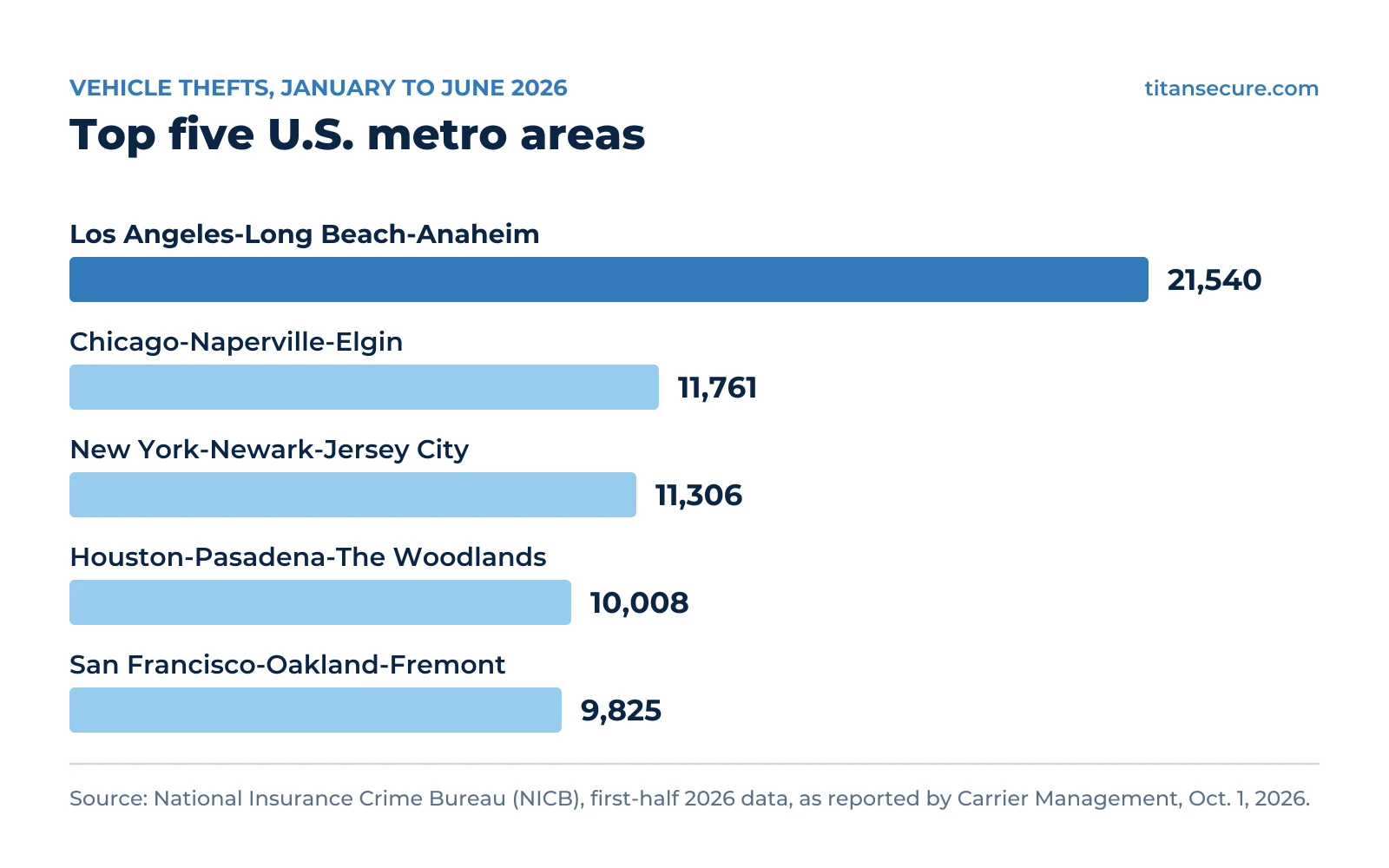
Two of the top five metros are in California. Chicago was the only one of the ten worst-hit metros where thefts went up, by about 2%.
A national drop of a fifth in a single year is real progress. It doesn't change the fact that Southern California is still where a vehicle is most likely to be stolen.
Why Fewer Thefts Isn't the Same as Safer
The easy thefts are falling. What is left is more organized, and it looks different.
- Relay attacks. One device picks up a keyless fob's signal from inside a house and passes it to a second device at the car, which then unlocks and starts as if the key were there.
- Key programming. A new key is programmed through the diagnostic (OBD) port in a matter of minutes.
- Signal jammers. A cheap jammer stops a tracker from reporting where the car is going.
- Trackers cut out. Once the car is somewhere quiet, the tracker is found and removed.
None of these needs a broken window or a damaged ignition. The car leaves looking like its owner is driving it.
Carmakers now accept that key cloning is a real problem. On October 30, Honda announced a deterrent kit that stops thieves using the OBD port to program new keys on 2023 and newer Accord, CR-V and Pilot models.
We wrote more about how each of these methods works, and what stops them, in Relay Attacks, Key Cloning and GPS Jammers.
Recovery Versus Prevention
When a stolen car is recovered, it gets counted as a good outcome. For the owner it usually still means a claim, days or weeks without the vehicle, damage to repair and a deductible to pay. For a dealer or a fleet, it means a unit that can't be sold or used while it is gone.
GPS has been sold as an anti-theft product, which it is not. A tracker tells you where the car went. It does nothing to stop it leaving, and the thefts that remain are the ones most likely to jam or remove it.
Recovery is too late. The useful question is whether the vehicle can be driven away at all. Here's how Titan compares with GPS trackers, and why tracking is no use once the car is already gone.
Three Things to Do Now
- Keep keyless fobs in a signal-blocking pouch at home and at work, so there is nothing for a relay device to pick up.
- Ask your dealer what any installed security add-on actually does, and who controls it. Does it stop the car from starting, or only report where it is?
- For fleets and dealer lots, make sure vehicles can't be driven away after hours, not just located after they've gone. See how Titan protects dealer inventory.
The first-half numbers show that thefts can come down quickly. In Southern California, the work now is stopping the thefts that are left, before the car is gone.